By Pallab Ghosh
Science correspondent, BBC News
I will tell you things at random

Travelling back on the train to Chichester from a visit to the Wildfowl and Wetlands Trust [WWT]'s 26 hectace Wetland Centre in Arundel, I pick up a copy of The Times and find an obituary for the composer and explorer, David Fanshawe.
One of many joys of the Cafe Aman concert was that the line-up had an acoustic bass guitar, an instrument that is almost anonymous. Since I first met the ABG some 25 years ago, I come across it perhaps 6 or 7 times in the interim.The acoustic bass guitar (also called ABG or acoustic bass) is a bass instrument with a hollow wooden body similar to, though usually somewhat larger than a steel-string acoustic guitar. Like the traditional electric bass guitar and the double bass, the acoustic bass guitar commonly has four strings, which are normally tuned E-A-D-G, an octave below the lowest four strings of the 6-string guitar, which is the same tuning pitch as an electric bass guitar.
Ashley Hutchings was the first player I came across in the mid-1980s when the Albion Band played for Leicester Haymarket's production of Lark Rise [the National Theatre version by Keuth Dewhurst], and All Things Considered, the support band for Lisa Knapp at Bracknell when I toured with Lisa over a year ago was the last.
So many thanks to Nick Cohen making a good evening great.
Last night I was mixing the sound for Martha Lewis' Cafe Aman at St. John's Chapel as part of this year's Chichester Festivities.
Giant clouds of interstellar gas and dust light up this panoramic view of the sky recorded by the European Space Agency's Planck telescope.
The space telescope was launched in May last year on a mission to survey the "cosmic microwave background" – ancient light left over from the big bang.
The bright streak across the middle of the picture is our own galaxy, the Milky Way, viewed edge-on. The intense light comes not from stars but from the radiation released by the dust and gas clouds that stretch between them.
"We are opening the door to an El Dorado where scientists can seek the nuggets that will lead to deeper understanding of how our universe came to be and how it works now. The image itself and its remarkable quality is a tribute to the engineers who built and have operated Planck," said David Southwood, director of science and robotic exploration at the European Space Agency (Esa).
The blue and white wisps that reach above and below our own galaxy are streamers of cold dust that trace out the "galactic web" where new stars are born.
The speckles at the top and bottom of the image are caused by microwave background radiation, the remnants of the first light that appeared 380,000 years after the big bang flung the universe into being 13.7bn years ago.
The Planck telescope observes the sky in nine wavelengths from the microwave to the vary-far-infrared region of the spectrum. This image is a composite of pictures taken at several different wavelengths.
The pictures beamed back by Planck will give astronomers insights into the structure of the universe and hopefully shed light on dark energy, which is believed to drive the expansion of the universe, and dark matter, the invisible substance that seems to cling to galaxies.
"This image is just a glimpse of what Planck will ultimately see," said Jan Tauber, Planck project scientist at Esa.
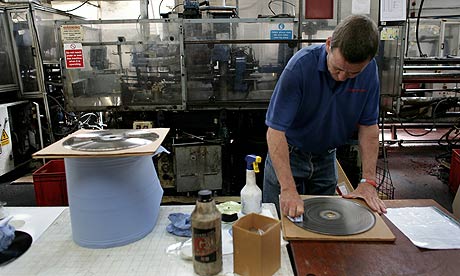
Vinyl may have been overtaken by CDs and downloads but it still has passionate fans, with the last major plant in the Uk pressing about 25,000 records a week on its 40-year old presses
Forty-year-old record presses, installed by EMI in the 70s vinyl heyday, grind noisily away, oozing hydraulic oil on to the floor. Long pipes run the length of the factory floor, carrying steam to power the presses. It's as if the digital age has never occurred.
Hi-tech this is not, but über-cool niche it certainly is. I'm on an industrial estate in Hayes, Middlesex. This was once the EMI vinyl manufacturing plant, until the record label sold it off in 2001, and it became the Vinyl Factory. In the 70s this plant pressed 1m records a week. It's now the last major vinyl plant in the UK and presses around 25,000 records a week.
General manager Roy Mathews began work here straight after school as an apprentice. That was 50-odd years ago. In those days the Beatles and Pink Floyd used to trail through the factory, keen to see their records (Sergeant Pepper's Lonely Hearts Club Band and The Dark Side of the Moon no less) being pressed. Mathews met them all, but no such thing happens today. The stars don't do factory visits any more; it's a reality too far.
But while CDs and downloads have taken over the market, vinyl itself has never lost its credibility. Devotees cite its superior sound quality and the personal, tactile relationship one develops with the big black disc and accompanying artwork. The Vinyl Factory's mission statement is: "Music is a physical experience." What's more, vinyl is experiencing a resurgence. Massive Attack, Grace Jones, The Pet Shop Boys and Mumford & Sons have all pressed limited runs here.
Mathews pulls out a black LP called the "lacquer". This is the master cut that the Vinyl Factory receives from Abbey Road Studios. It's an aluminium disc coated in acetate lacquer into which an analogue signal has been cut using a heated diamond stylus. At this point, the disc is a soft facsimile of the final record.
We move to the hub of the factory floor, where an assistant cleans the surface of the lacquer using distilled water and then softly brushes it using soap solution to remove any grease before placing it in the silver plating tank, where mechanical jets shower the disc with a thin layer of silver to make it electrically conductive.
Before our eyes the disc gathers a beautiful silver sheen. It is then placed in an electroplating bath where, over three hours, individual nickel molecules attach themselves to the silver. The resulting "master" is washed and separated from the original lacquer. As this master is now a negative imprint, another positive nickel copy is made, called the "mother".
The mother copy is played and checked for faults. All being well, negative nickel "stampers" are then produced from the mother. These are cleaned and used to press the final run of records.
Mother, master, stamper, positive, negative: I am initially bemused by Mathew's flood of terminology. To him it's clearly second nature; after half a century, vinyl manufacturing is stamped on his brain indelibly.
A pile of paper record labels are placed in a record press. The vinyl arrives in the form of black PVC pellets contained in a large vat with spidery tubes running out of it and into several large presses. The pellets are sucked up the tubes and into the sealed press and melted at high temperature. A sausage of black vinyl is squirted out, into a circular block, which is sandwiched between two record labels before being flattened between the A and B side stampers. The excess PVC that seeps out of the sides is trimmed off and dumped in a bin. It is fearsomely hot to touch.
The press then produces a perfectly round, covetable finished disc that it slots into a sleeve before depositing it in an adjacent box. Once a run is complete, the used stamper is removed and the next one is cleaned with pressurised air to get rid of any grit, slotted into place and screwed in, ready for the next run.
Warm, noisy and greasy, these old machines keep on keeping on. The pristine records they produce belie the frankly rather clapped-out looking machines that continue to manufacture them. Old school engineering triumphs here. Nothing has changed. But why tinker with perfection?

Another review of Garret Keizer's book The Unwanted Sound of Everything We Want: A Book About Noise published by Perseus, this tiome in the Guardian Review, by Steve Poole
Scientists have simulated the sounds set to be made by sub-atomic particles such as the Higgs boson when they are produced at the Large Hadron Collider.
Their aim is to develop a means for physicists at Cern to "listen to the data" and pick out the Higgs particle if and when they finally detect it.
Dr Lily Asquith modelled data from the giant Atlas experiment at the LHC.
She worked with sound engineers to convert data expected from collisions at the LHC into sounds.
"If the energy is close to you, you will hear a low pitch and if it's further away you hear a higher pitch," the particle physicist told BBC News.
"If it's lots of energy it will be louder and if it's just a bit of energy it will be quieter."
The £6bn LHC machine on the Swiss-French border is designed to shed light on fundamental questions in physics.
It is housed in a 27km-long circular tunnel, where thousands of magnets steer beams of proton particles around the vast "ring".
At allotted points around the tunnel, the beams cross paths, smashing together near four massive "experiments" that monitor these collisions for interesting events.
Scientists are hoping that new sub-atomic particles will emerge, revealing insights into the nature of the cosmos.
Atlas is one of the experiments at the LHC. An instrument inside Atlas called the calorimeter is used for measuring energy and is made up of seven concentric layers.
Each layer is represented by a note and their pitch is different depending on the amount of energy that is deposited in that layer.
The process of converting scientific data into sounds is called sonification.
Dr Asquith and her team have so far generated a number of simulations based on predictions of what might happen during collisions inside the LHC.
The team is only now feeding in real results from real experiments.
"When you are hearing what the sonifications do you really are hearing the data. It's true to the data, and it's telling you something about the data that you couldn't know in any other way," said Archer Endrich, a software engineer working on the project.
The aim is to give physicists at the LHC another way to analyse their data. The sonification team believes that ears are better suited than eyes to pick out the subtle changes that might indicate the detection of a new particle.
But Richard Dobson - a composer involved with the project - says he is struck at how musical the products of the collisions sound.
"We can hear clear structures in the sound, almost as if they had been composed. They seem to tell a little story all to themselves. They're so dynamic and shifting all the time, it does sound like a lot of the music that you hear in contemporary composition," he explained.
Although the project's aim is to provide particle physicists with a new analysis tool, Archer Endrich believes that it may also enable us to eavesdrop on the harmonious background sound of the Universe.
He said he hoped the particle collisions at Cern would "reveal something new and something important about the nature of the Universe".
And Mr Endrich says that those who have been involved in the project have felt something akin to a religious experience while listening to the sounds.
"You feel closer to the mystery of Nature which I think a lot of scientists do when they get deep into these matters," he said.
"Its so intriguing and there's so much mystery and so much to learn. The deeper you go, the more of a pattern you find and it's fascinating and it's uplifting."

The headline in Charlotte Higgin's diary from the Hay Festival in today's Guardian reads Diva Minchin's rider demands. 
The Freesound Project aims to create a huge collaborative database of audio snippets, samples, recordings, bleeps, ... released under the Creative Commons Sampling Plus License.
And Creative Commons is a nonprofit corporation dedicated to making it easier for people to share and build upon the work of others, consistent with the rules of copyright.
The trainer at the gym is looking at my left shoulder. He presses a spot at the base of my neck with his thumb, causing a deep twinge that runs all the way down my left arm, and whistles in ironic admiration. People who work in physiotherapy are invariably impressed by how tense I am. I'm like a giant fist, permanently clenched in anxiety.
"It could be from the way you sit while you work," he says. "You probably lean forward when you type."
"Probably," I say.
"But it's odd it's only on one side."
I know exactly what it's from; I just don't want to tell him. It's from playing the banjo.
When I took up the banjo three years ago, I thought of it as a harmless pastime, or at least as a pastime that would harm only others. When I joined a band last year, I didn't imagine I was following a path that would inevitably lead to injury.
But being in a band means keeping up with other musicians, and I have some unfortunate history here. When I was in the City Youth orchestra, I had to teach myself the violin without making any noise, the bow hovering just above the strings, because any noise I made was the wrong noise. When I was in a band in college, I was always on the verge of being kicked out for my lack of application. When you hang out with students who drink beer, smoke pot and play guitars all day, establishing yourself as the lazy one is no mean feat, but I managed it.
This time I don't want to be left behind, and I have vowed to attack musicianship with as much dedication as I can muster without inviting unwanted sarcasm from my wife. As part of this new ambition, I have devised a banjo arrangement for a song that is both fiendishly complex and nakedly impressive.
Or it would be if I could play it, but I can't. I spend most of my time sitting at my desk, banjo on my knee, running over the same notes at half speed and staring at a blank computer screen. The ritual might be calming if progress were in any way perceptible. After a few hours of frustration, I go downstairs to the kitchen, where my wife is sitting.
"Working hard?" she says. "Plinkety plink."
"It helps me think," I say. At that moment I'm thinking: index, middle, thumb, middle, thumb, index, middle, thumb. "My neck hurts."
"I see," she says. "Anything else to report?"
"Next week's gig is cancelled," I say, looking out the window. "But the rehearsal is still on, because the studio was already booked."
"Oh, are we still talking about you?" she says. "How interesting."
So I have failed to master the banjo part, I have failed to evade my wife's sarcasm and I am now unable to look over my left shoulder. There has been some progress – I've learned to type with finger picks on my right hand – but I'm still worried about holding the band back.
The next evening my wife catches me in the hall as I'm preparing to leave with my banjo case.
"Where are you going?" she says.
"Acton," I say.
"What for?" she says.
"Rehearsal," I say. "It's Thursday."
"It's election night," she says.
"Yes," I say, "so it is. But, I mean, there's never really any news before midnight. I'll be back by then."
"We're having a party," she says. "Eight people are coming to dinner."
"Are they?" I say. "Well, in that case, um…" I stop, poised between two competing commitments, feeling obliged to weigh my next words carefully. I breathe out and think: index, middle, thumb, middle, thumb, index, middle, thumb
The singer's field recordings for the National Trust are the most radical, forward-thinking music of the year

Rock and pop music, and assorted mutant sub-genres, is so everyday, so available, so not as special as it once was before it became so much a part of our surrounding world, it's interesting to wonder if there might be some sort of replacement as the 21st century develops for that kind of mind-shattering combination of sound, science, art, rhythm and image.
The release of yet another nicely made single or album by yet another solo act or group lined up for yet another award show or festival or item of gossip, yet another product given four stars and a spray of compliments, does not really set the blood racing, however pleasant or even surprising it might be. Pop has made its self-assertive point, very well, and it's taken over, but it's no longer the shock to the system it once was. It turns over, recycling, requoting, refining, reproducing, and all its delectable secrets have been more or less revealed. It's just one ingredient in a general cacophony where everything, even a sort of avant garde, is marketable and participants, effects, poses, beats, conceptual flourishes are all familiar.
Will something emerge that will be as unrecognisable to us now as, say, the Velvet Underground, Kraftwerk, Sly Stone, Jimi Hendrix orCan would have been in 1910? Something that is more about the subversive, deliberately ambiguous ideas it carries with it, and not tired notions of coolness and hipness and career opportunities? The pop and rock era might yet be a part of the latest stage in a journey that means what happens musically in the next 100 years is even more exciting that what has just happened. But that means change that changes everything.
There were early clues to what was to emerge in the 60s and beyond – Duchamp, the blues, the idea of the edit, cubism, futurism andRossolo's Art of Noises, Rimbaud, Ravel, jazz, the microphone. To some extent, what happens next might still refer back to that particular narrative but from post-musique concrete, post-rock, post-computer, post-sampling, post-interactive positions which are generating new contexts where genuine radicalism can emerge.
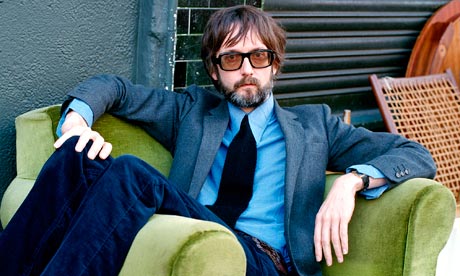
Oddly, this brings me to Jarvis Cocker and the deadpan collection of field recordings he has produced on behalf of the National Trust (free to download at its website) – a bringing together of small sounds from everyday life, faithful recordings of birdsong, gravel paths, creaking stairs, lapping water and chiming clocks. It's not at the avant-garde edge of classical music (as represented by Cage, Schaeffer, Oliveros, Lucier or Varèse's "liberation of sound"), or at the pop edge of the avant garde (from Eno, Fripp and Czukay to glitch etc) – and it sounds quite quaint next to, say, Janek Schaefer's stimulating, sophisticated assemblies or ex-Cabaret Voltaire member Chris Watson'shallucinatory nature recordings.
But from a friendly, loved pop face, it constitutes a thoughtful proposal that this kind of contemplation of sound, involving the pure isolation of its surface, depth and mysterious presence, can be a discreet reminder of the experimentally achieved occult electro-sonic qualities that are a key part of pop's appeal. It's a polite reminder that music, however it is assembled, whatever it consists of, however it is classified, is about the mind and the imagination as much as it's about buying, swapping, listing and grading music and reminding you of your past.
Cocker's pause-for-thought souvenir of time, place and sensation suggests a ghostly hint of what musically comes next in what has become known, drearily, as sound art – which is sonic sculpturing, the transformative integration of music and art, a continuation of John Cage's challenging observation in 1937 that music was now "the organisation of sound". Cage rejected composition in the traditional sense in pursuit of an energising new music that combined randomness, found sound, recording, theory and manipulation with rigorous compositional perception.
As a judge on the PRS for Music Foundation's New Music award, which is giving £50,000 in September to fund the compositional construction of an innovative new work, I'll let you know during the next few months about the shortlist and further possible hints of the emergence of a post-recording-era hybrid unrecognisable to us now. As Cocker implies with his dreamy National Trust recordings, the future of music, its next progressive steps, might have more to do with Cage's patient, exploratory theories about thinking and hearing than with the busy, blatant success of pop in making its presence felt time and time again.