Monday, 27 June 2011

String Theory

Steven Appleby managed to get my frustration about spiders webs of mic cables off to a tee.

Thursday, 6 January 2011

£4.33 for 4'33"

Someone at Edition Peters has a sense of humour if the letter about Cage's score in the Guardian is anything to go by.

I was tickled when I bought my John Cage score (Letters, 3 January) at a performance at the Barbican a few years ago – it was priced at £4.33.
Iain Fraser
Bedford

Monday, 3 January 2011

3 versions of 4'33"

I was intrigued by Andrew Mitchell's reference to 3 differing versions of the score, so I followed up on Edition Peters website.

Here's what it had to say:

The so-called First Tacet Edition: a typewritten score, lists the three movements using Roman numbers, with the word "TACET" underneath each. A note by Cage describes the first performance and mentions that "the work may be performed by (any) instrumentalist or combination of instrumentalists and last any length of time." Edition Peters No. 6777 (out of print).

The so-called Second Tacet Edition: same as the First, except that it is printed in Cage's calligraphy, and the explanatory note mentions the Kremen manuscript. Edition Peters No. 6777 (i.e. it carries the same catalogue number as the first Tacet Edition)

The Kremen manuscript (1953): graphic, space-time notation, dedicated to Irwin Kremen The movements of the piece are rendered as space between long vertical lines; a tempo indication is provided (60), and at the end of each movement the time is indicated in minutes and seconds EP No. 6777a.

The premiere of the three-movement 4'33 was given by David Tudor on August 29, 1952, at Woodstock, New York as part of a recital of contemporary piano music. The audience saw him sit at the piano and, to mark the beginning of the piece, close the keyboard lid. Some time later he opened it briefly, to mark the end of the first movement. This process was repeated for the second and third movements. The piece had passed without a note being played—in fact without Tudor (or anyone else) having made any deliberate sound as part of the piece. Tudor timed the three movements with a stopwatch while turning the pages of the score.

"They missed the point. There's no such thing as silence. What they thought was silence, because they didn't know how to listen, was full of accidental sounds. You could hear the wind stirring outside during the first movement. During the second, raindrops began patterning the roof, and during the third the people themselves made all kinds of interesting sounds as they talked or walked out." - John Cage speaking about the premiere of 4'33".

For a full history of 4'33" visit the wikipedia entry here: http://en.wikipedia.org/wiki/4'33"

Responses on 4'33"

The Guardian didn't publish my letter in response to Julian Oddy, but they did print 3 other letters...

Julian Oddy (Letters, 1 January) has a very good chance of buying the score of John Cage's 4' 33" – a copy was prominently displayed in Foyles just before Christmas. I was quite tempted myself, but my sight reading is hopeless.
Tim Davies
London

It can be bought from Peters, whose website explains the difference between the three versions they have published (two in print, one out of print).
Andrew Mitchell
London

It's in three movements, each marked "tacet".
Jason Hazeley
London

Guardian reviews "The Wire"

For once I am able to comment on a radio review. Elisabeth Mahoney review's yesterday's Radio 4 programme, "The Wire", in today's Guardian.


The Wire (Radio 4, Sunday) was a curious tale of obsession. Sound recordist Chris Watson told the story of those fixated with the peculiar, haunting noise that emanates from telegraph wires when the wind crosses and envelops them. The programme began with a rush of this spooky sound, all pings and static and creepy growling.


Watson described the noise as "some of the strangest and most beautiful sounds I've ever heard", adding that as he listened to it there were "six or seven grey kangaroos" in front of him. He was in Australia, where artist-led Wired Lab Project celebrates this aural phenomenon.
There was an intensity to the way the artists explained their passion, and a smidgeon of the geek as they detailed the technical process of recording the odd hum. One chap recalled recording the noise all night; another suggested the sound was akin to "the sound of a cell".


But there was magic, too. As we listened to the wind strumming the wire, the sound suddenly contracted and went high-pitched. "All the sound just changed completely," we heard. "It's because the sun came out." Watson, who knows all about the power of sounds to convey a moment, place or creature, was mesmerised by the interplay of weather and wire, and the brooding poetry it can make.


Sunday, 2 January 2011

The Music of the Wires

Just finished listening to Chris Watson's programme of Radio 4. Fascinating. catch on listen again on the BBC iPlayer until Sunday 09 January 2011.

The BBC website has more information and links, including the Wired Lab Project.

Now where are my Alan Lamb CDs filed? Sound Art? Environmental recordings? Modern Music? And physical of hidden on my laptop?

Saturday, 1 January 2011

A score for John Cage's 4'33"?

Julian Oddy, in his letter in today's Guardian, obviously thinks that the printed score to John Cage's composition, 4'33", is a mythical entity - along the lines of skyhooks, long waits and a written British Constitution.

A short time ago you published my letter asking where I could purchase a copy of the British Constitution - sadly to no avail. I should now like to buy the score of John Cage's 4'33". Will I have a better chance?

Julian Oddy

Weymouth, Dorset

Of course he does. Here's my response.

Dear Sir

Why does Julian Oddy think that it is impossible to notate John Cage's 4'33".

I bought my copy of the score [in 3 movements] several years back, along with a copy of it on a T-shirt which I've been wearing proudly over the past few weeks, from his publishers Edition Peters.

Yours faithfully

Paul Bull


Exeter, Devon


Thursday, 30 December 2010

Chris Watson - "The Wire"

I love the work of wildlife sound recordist Chris Watson - but even better is hearing him talk about his passion.

So the preview in the latest Time Out has certainly whetted my appetite...

SUNDAY 02 Jan 2011
The Wire
1.30-2.00/R4

Wildlife sound-recordist Chris Watson meets artist/scientist Alan Lamb, who has been fascinated all his life with the sounds that telegraph wires stretched across the landscape make when they are 'played' by the wind. He has worked with abandoned wires across Australia and installed new structures to produce music, recording what he hears, and researching of auditory perception. A fascinating subject, and perfect radio material.

Sunday, 7 November 2010

How green is my download?

The Observer magazine has an interesting article by Lucy Siegel in the "It's not easy being green..." series - pondering if downloading is more carbon efficient than buying a CD.

Can I download and be green?
Downloading a music album exacts the same environmental price as making tea for 12

As we hurtle through the digital age, we tend to do so confident that new technology makes everything cleaner and greener. Kate Craig-Wood, founder of Memset, a managed hosting and cloud-computing provider, has taken a closer look at music downloads.

She based her calculations on a large sample group of servers, factoring in cooling and infrastructure losses in data centres although not the energy used to run the home network and PC or laptop. The headline news is that she found you could drive two miles in a small electric car or make tea for 12 people on the energy required to download and deliver a music album.

The point is that there is a carbon penalty for downloading, despite the physical lack of a CD. The energy used by downloads is around 7kWh per gigabyte (the average album will be in the region of 100MB). But downloading is still 40-80% more carbon efficient than buying a CD.

Alison Tickell, founder of juliesbicycle.com (strapline: taking the heat out of the music industry) is of the opinion that the CD-versus-download green debate should be retired. The march of downloads is inevitable – one track might be stored on multiple MP3 players or servers or burned on to CDs and all require different amounts of power. Responsible downloading isn't a sexy title but it's the next big hit.

Thursday, 15 July 2010

Credit where credit's due

The previewer of BBC1's stunning thriller The Silence in the Sunday Times Culture section says something along the lines "it's not often that you seek out the name of the sound designer" yet fails to mention who did the extremely fine work on sound.


But they're not alone, the BBC website on the programme fails to list many beyond director and producer.


And the credits roll too fast and are too small to be of much help.


So full marks to Douglas Hensall who lists many of the technical and crafts personal involved.


So I can name names and give credit where credit's due:

Sound Mixing: Karl Merren

Composer: John Lunn

Saturday, 10 July 2010

Naming of names

So today's Guardian WeekendMagazine reveals who was responsible for the vuvuzela! It's Freddie Maake.

Experience: I invented the vuvuzela
'At the start of the tournament, I was standing at the top of the arena near the players, listening to the sound and crying tears of joy'

'There has been talk of a ban, but that will never happen while I'm still alive'

I invented the vuvuzela 35 years ago but, of course, it's only since the start of the World Cup that it has become quite so well known globally. Whatever people may say about the sound it makes, it has never been so popular. That makes me proud; I see so many visitors taking vuvuzelas home with them, to Europe, South America and beyond.

I know people have complained in the past. One football squad objected to the noise when they played in South Africa, but I think it's only polite to accept the customs of any country you visit, and this is our culture. Our players expect it and the sound encourages them – it's the sound of our support. Many people say they don't like the noise, but I've been blowing the vuvuzela for decades now and I've never heard of anyone going to hospital or dying because of it.

I do recommend some basic rules when it comes to using it, though – you shouldn't blow one directly into anyone's ear, for example, nor should you ever sound a vuvuzela during a country's national anthem. There has been talk of a ban, but that will never happen while I'm still alive – no government will stop it. The vuvuzela is my baby and I'd happily go to jail for it. Actually, I have been locked up already, for 20 minutes – in 1992, I took my vuvuzela to Zimbabwe, but only after falling foul of the authorities at the airport, who initially insisted I couldn't take it on to the plane.

I have been dedicated to popularising the vuvuzela since 1965, when I was 10. My brother bought me a bicycle to ride to school on. It had a big aluminium hooter with a rubber bulb on the end – I realised if I took off the ball and blew into the horn, it made a more exciting noise. I used to take it along to local football matches played on gravel or in the street and play it to encourage my team.

My horn became better known a few years later when the Kaizer Chiefs football club was born – I never missed a game and I'd always take it along. I used to call it a lempororo, after the area in South Africa where I grew up. Other supporters would ask where I'd got it, but because the lempororo was made of metal, it was considered dangerous and I was banned from taking it into the Orlando Stadium where the Chiefs used to play.

I approached someone who ran a manufacturing company and he made the first plastic version – a yellow one very much like those you see today. We called them Boogieblasts and sold them at games. I changed the name to vuvuzela in 1992, after Nelson Mandela was released and South Africa was allowed to compete internationally again – the name means three things in Zulu: "welcome", "unite" and "celebration."

People assume my invention has made me rich – in fact, big companies have taken the idea and the name, and don't give me a penny. I struggle to feed my nine children. Most of my earnings come from selling an album I made in the 90s that features the vuvuzela, and I've been touting the second volume at the World Cup games. Of course I'd be happier if my invention allowed me to support my family more easily, but I'm not bitter that others are benefiting. I still want to encourage others to enjoy them. When South Africa hosted the 1995 Rugby World Cup, I had vuvuzelas made in all the teams' colours and taught people in the crowd how to play.

In my culture, it's hard to gain recognition when you do something good – not while you're alive, anyway. When I do pass away, I want people to blow vuvuzelas at my funeral. It gives me great joy to know that I created an instrument that has been played by everyone from tiny children to Nelson Mandela. Even now I spend a lot of time thinking of ways to improve it; I want everyone to play the vuvuzela, beyond Africa.

At the start of the tournament, I was standing at the top of the arena near the players, listening to the sound and crying tears of joy. People from all over Africa were there, united by the vuvuzela. As for players saying they can't hear on the pitch because they're drowned out by the noise – well, footballers have never been short of excuses when things go wrong, have they? Whatever happens tomorrow, you'll never hear the winning team complaining.

• As told to Chris Broughton.


Friday, 9 July 2010

Shocking Sounds

I've never really looked at the Clip Joint section of the Film & Muisc supplement of the Guardian. However, this week's selection from AJ Bee was rather tasty - they're all on the theme of horror sounds, and as well as the reader's thoughts there are actual clips to watch and listen to

AJ writes:
When it comes to cinema, sound is often sight's neglected sister. Yet all things aural feed our mood, while an absence of sound leaves scenes cold. This is why sound is a key tool of the filmmaker with a desire to genuinely affect their audience. Fingernails screeching down a blackboard signalled an ominous presence in Jaws, while the industrial grind of Eraserhead pummels the viewer into a paranoid wreck.

The darker side of cinema is often home to the most creative use of audio. For those who can't afford CGI, the experienced sound engineer proves invaluable. Who would have thought that The Exorcist's head-turning scene was made especially dread-drenched by the creak of a leather wallet? These skilfully added acoustics may be a backdrop for the movie, or part of the plot itself. They are a secret narrator in our minds, skilfully and invisibly steering our emotions. Often misused by studio hacks to shock the viewer into supposed terror through volume (or possibly just to keep us awake) sound is still, for good or for ill, a central element of the scary cinematic experience.

1) Alan Bates opens his mouth, destroys a shepherd and damages John Hurt's eardrums in The Shout.
2) Bernard Herrmann's shrieking strings in Psycho terrify us into thinking we've witnessed violence that we haven't.
3) In Requiem for a Dream sound conjures up one woman's paranoid psychosis (plus the most dangerous fridge outside Ghostbusters)
4) David Lynch uses sound in Eraserhead to gradually wear down the viewer, leaving us a gibbering mess.
5) A cocktail of surreal, layered sound and image make the 1977 comedy horror Hausu an unforgettable experience

David Fanshawe RIP

Travelling back on the train to Chichester from a visit to the Wildfowl and Wetlands Trust [WWT]'s 26 hectace Wetland Centre in Arundel, I pick up a copy of The Times and find an obituary for the composer and explorer, David Fanshawe.


The accompanying picture shows him holding a pair of Sennehiser MD421 microphones for a location recording. The large diaphragm, dynamic element handles high sound pressure levels, making it a natural for miking brass and drums [especially toms], although it is rarely seen nowadays.

I first discovered David in the early 1980s through the wonderous African Sanctus, an unorthodox setting of the Latin Mass harmonised with traditional African music recorded by the composer on his now legendary journeys up the River Nile (1969-73). The taped music from Egypt, Sudan, Uganda and Kenya is heard in counterpoint with the live chorus, soprano soloist and instrumental ensemble.


As The Times has a paywall, there is an obituary on the Independent website.

David Fanshawe: Composer and explorer best known for 'African Sanctus'

On accepting an honorary degree as a Doctor of Music at the University of Bristol last November, the composer and explorer David Fanshawe described his "life's missions": "to celebrate the universal language of music; to record for posterity endangered World Music, threatened with extinction; to seek inspiration for my own compositions – thus uniting musical worlds apart."

His best-known and most influential work was African Sanctus (Philips, 1975), which fused a choral mass with field recordings of traditional music he had made on extensive travels in Africa between 1969 and 1975, and won him an Ivor Novello Award. That year, the project was also the subject of his only published book, and a BBC TV documentary.

When co-editing the first edition of The Rough Guide to World Music (1994), the writer and film-maker Simon Broughton wrote a chapter based largely on an interview with Fanshawe about his later work in the Pacific. He described Fanshawe's legacy: "His importance was in pioneering enthusiasm for other musical cultures and using them in a new way of composing – seeing the BBC film about African Sanctus was without doubt one of the things that made me realise how much amazing music there is in the world."

David Fanshawe was born in Paignton during an air raid. He was educated at St George's School, Windsor and Stowe, where he struggled with mild dyslexia but showed promise in film, music and drama. On leaving school in 1959 he landed a job at a small film company in Wimbledon, Merton Park Productions, but soon set off on the first of his travels, to Europe in 1962.
In 1965 he won a Foundation Scholarship to study under John Lambert at the Royal College of Music, and in 1966, produced his first significant work the 17-minute orchestral piece Requiem for the Children of Aberfan. The same year he also began exploring the Middle East, which led him to compose Salaams (1970) a work based on rhythms he had learnt from pearl divers in Bahrain.

Between 1969 and 1975 he travelled widely in North and East Africa, partly funded by the Ralph Vaughan Williams Trust and a Churchill Fellowship. This resulted in around 600 field recordings of the indigenous musicians he met and gained the trust of, some of whose work went into the creation of African Sanctus.

While based in London between trips during the 1970s, he also pursued a successful parallel career composing scores for over 30 films and television programmes, including Tarka the Otter, When the Boat Comes In, Three Men in a Boat, England their England and Softly, Softly. However, the travel bug bit again in 1978, when he began to explore the Pacific region. By 1981, with his then wife Judith and their two young children, Fanshawe relocated to Fiji, which he used as a base for his travels. Back in London and divorced by the middle of the decade, he remarried and resettled in Australia, from which he continued his journeys through Melanesia, Micronesia and Polynesia. He eventually made around 2,000 recordings.

The family returned to the UK in 1992, settling in Wiltshire, where Fanshawe established his archives and continued to compose. From the mid-1990s on, a number of his field recordings were released on the ARC, Saydisc and Nonesuch labels.

Aside from African Sanctus, Fanshawe's work has been the subject of three other documentaries: Arabian Fantasy (1976), Musical Mariner (1987) and Tropical Beat (1995). Significant later compositions include Fanfare to Planet Earth, Millennium March and Pacific Song – a movement for choir, flute and drums, inspired by Tongan music – the only completed part of his planned Pacific Odyssey.
Jon Lusk
David Arthur Fanshawe, composer and explorer: born Paignton, Devon 19 April 1942; married firstly Judith Croasdell Grant (one son, one daughter), secondly Jane Bishop (one daughter); died Swindon 5 July 2010.

Wednesday, 7 July 2010

Acoustic bass uuitar

One of many joys of the Cafe Aman concert was that the line-up had an acoustic bass guitar, an instrument that is almost anonymous. Since I first met the ABG some 25 years ago, I come across it perhaps 6 or 7 times in the interim.

The acoustic bass guitar (also called ABG or acoustic bass) is a bass instrument with a hollow wooden body similar to, though usually somewhat larger than a steel-string acoustic guitar. Like the traditional electric bass guitar and the double bass, the acoustic bass guitar commonly has four strings, which are normally tuned E-A-D-G, an octave below the lowest four strings of the 6-string guitar, which is the same tuning pitch as an electric bass guitar.


Ashley Hutchings was the first player I came across in the mid-1980s when the Albion Band played for Leicester Haymarket's production of Lark Rise [the National Theatre version by Keuth Dewhurst], and All Things Considered, the support band for Lisa Knapp at Bracknell when I toured with Lisa over a year ago was the last.


So many thanks to Nick Cohen making a good evening great.


Tinnitus at the Cafe Aman

Last night I was mixing the sound for Martha Lewis' Cafe Aman at St. John's Chapel as part of this year's Chichester Festivities.

At the interval a gentleman came up to me and asked if it needed to be so loud - he was complaining that he was over 50 [as am I] and when you get to that age you get various afflictions such as the tinnitus that he was suffering from. So he was telling me to turn it down for the second half or he wouldn't be going back in.

While I do appreciate his discomfort, I spend my professional life working with sound and so would certainly do nothing to damage my own [or others] hearing.

In this case, the sound DID have to be at that level. Any quieter and the out-front sound would be compromised by the level of the on-stage monitors used by the performers, which in the smallish chapel were louder than I would have hoped.

A quick straw poll of some people I knew confirmed that they were not distressed by the sound levels [indeed, they complimented on the quality of the sound] and the stewards had no other complaints.

Our solution...my sound assistant had a pair of noise-reducing earplugs which he lent to the man. [I don't give up my own everpresent personal Etymotic ER-20 plugs - which reduce the sound by 20dB at all frequnecies - for nobody]. A happy customer after the concert.

But it begs the question: would he ask for the lighting to be turned down if he had a sight problem that was exacerbated by strong light. No, he would probably wear tinted glasses. Why is sound any different? I hope he takes up our visit Specsavers and purchase his own set.


Tuesday, 6 July 2010

Milky Way


Composite image of the universe with the Milky Way looming large in the foreground, from the European Space Agency's Planck telescope. Click on the magnifying glass to enlarge. Photograph: Esa

Giant clouds of interstellar gas and dust light up this panoramic view of the sky recorded by the European Space Agency's Planck telescope.

The space telescope was launched in May last year on a mission to survey the "cosmic microwave background" – ancient light left over from the big bang.

The bright streak across the middle of the picture is our own galaxy, the Milky Way, viewed edge-on. The intense light comes not from stars but from the radiation released by the dust and gas clouds that stretch between them.

"We are opening the door to an El Dorado where scientists can seek the nuggets that will lead to deeper understanding of how our universe came to be and how it works now. The image itself and its remarkable quality is a tribute to the engineers who built and have operated Planck," said David Southwood, director of science and robotic exploration at the European Space Agency (Esa).

The blue and white wisps that reach above and below our own galaxy are streamers of cold dust that trace out the "galactic web" where new stars are born.

The speckles at the top and bottom of the image are caused by microwave background radiation, the remnants of the first light that appeared 380,000 years after the big bang flung the universe into being 13.7bn years ago.

The Planck telescope observes the sky in nine wavelengths from the microwave to the vary-far-infrared region of the spectrum. This image is a composite of pictures taken at several different wavelengths.

The pictures beamed back by Planck will give astronomers insights into the structure of the universe and hopefully shed light on dark energy, which is believed to drive the expansion of the universe, and dark matter, the invisible substance that seems to cling to galaxies.

"This image is just a glimpse of what Planck will ultimately see," said Jan Tauber, Planck project scientist at Esa.

Saturday, 3 July 2010

Ten of the Best - Pianos

I tour as sound engineer with pianocircus. We usually have to play on digital keyboards [currently the Yamaha CP33 stage piano] but occasionally they get to play on - and I get to mike up - 6 grand pianos. As such, I've become a Steinway spotter - collecting serial numbers of pianos we use.

In a series I rarely look at in the Guardian Review, John Mullan in "Ten of the Best" today looks at the use of pianos in literature.

Emma by Jane Austen
It bruises Emma that Jane Fairfax is so very good at playing the piano (if only she had practised a little more). Jane's prowess at the keyboard becomes central to the plot. Who could be the donor of the expensive instrument that is delivered to Miss Bates's house, where Jane is staying? It must surely be a male admirer. Well, yes, but Emma's deductions lead her very astray.

Vanity Fair by William Makepeace Thackeray
Amelia and Becky – the good girl and the bad girl – both play the piano, but look at their different styles! After her husband's death, Amelia "spends long evening hours, touching . . . melancholy harmonies on the keys, and weeping over them in silence". Becky, meanwhile, entrances the wife of the man she is seducing with the bogus "tenderness" of her renditions of Mozart.

Jane Eyre by Charlotte Brontë
Jane can play the piano, of course – but Blanche Ingram, her rival for the attentions of Mr Rochester, can really play. She sits proudly at the piano, "spreading out her snowy robes in queenly amplitude" and beginning "a brilliant prelude; talking meantime". But this is showing off, and dooms her.

Daniel Deronda by George Eliot
The scary German piano maestro Herr Klesmer (based on Franz Liszt) has "an imperious magic in his fingers that seemed to send a nerve-thrill through ivory key and wooden hammer". His romance with heiress Catherine Arrowpoint is conducted via the instrument, which he teaches her to play brilliantly.

The Portrait of a Lady by Henry James
Entering the huge drawing room at Gardencourt unseen, Isabel Archer finds an elegant woman at the piano. "She was playing something of Schubert's . . . and she touched the piano with a discretion of her own. It showed skill, it showed feeling". It is the mysterious Madame Merle, her gifts as a pianist a sign of her sexual powers.

The Awakening by Kate Chopin
The piano awakens Edna Pontellier's dormant passions. "The very passions themselves were aroused within her soul, swaying it, lashing it, as the waves daily beat upon her splendid body. She trembled, she was choking, and the tears blinded her." Adulterous love is only a step away.

Piano by DH Lawrence
A woman sings at the piano, and the poet is carried back to his childhood, when he sat "under the piano, in the boom of the tingling strings / And pressing the small, poised feet of a mother who smiles as she sings". The music reduces him to tears for the past.

The Piano Players by Anthony Burgess
An accomplished musician himself, Burgess fills this novel with piano music. Ellen Henshaw, an elderly former prostitute, looks back on her own efforts to learn the instrument. Her father, a brilliant player, improvised accompaniments to silent films at the cinema. The disastrous climax of his career is a 30-day non-stop piano marathon.

The Piano Teacher by Elfriede Jelinek
Erika is a middle-aged piano teacher at a Vienna conservatory. She still lives with her mother, who wanted Erika to be a concert pianist and forced her to practise. The piano inevitably becomes the focus of Erika's sadomasochistic affair with a teenage student, to whom she gives some very steamy lessons.

The Bradshaw Variations by Rachel Cusk
Thomas has become a househusband and, when his wife goes off to run some university department or other, he fulfils a long-held ambition: to become really good at the piano. Pausing from practice to do the odd school run, he escapes from the turmoil of mid-life dread into the harmonies of the keyboard. Except, of course, that it will prove to be no escape at all . . .

Saturday, 26 June 2010

How to make a vinyl record

I am of the generation old enough to have seen people in lab coats working in sterile conditions in the basement of the old Virgin Megastore on Oxford Street to manufacture COMPACT DISCS.

Yes, there was no chance of burning them on your laptop then - because we didn't have laptops. Even in 1996 I was still have to go to a specialised duplicating studio if I needed custom CDs burnt for particular projects.

So the following article by Melissa Viney in the Disappearing Acts feature in the Work section of today's Guardian was fascinating.

How to make a vinyl record

Vinyl may have been overtaken by CDs and downloads but it still has passionate fans, with the last major plant in the Uk pressing about 25,000 records a week on its 40-year old presses

Forty-year-old record presses, installed by EMI in the 70s vinyl heyday, grind noisily away, oozing hydraulic oil on to the floor. Long pipes run the length of the factory floor, carrying steam to power the presses. It's as if the digital age has never occurred.

Hi-tech this is not, but über-cool niche it certainly is. I'm on an industrial estate in Hayes, Middlesex. This was once the EMI vinyl manufacturing plant, until the record label sold it off in 2001, and it became the Vinyl Factory. In the 70s this plant pressed 1m records a week. It's now the last major vinyl plant in the UK and presses around 25,000 records a week.

General manager Roy Mathews began work here straight after school as an apprentice. That was 50-odd years ago. In those days the Beatles and Pink Floyd used to trail through the factory, keen to see their records (Sergeant Pepper's Lonely Hearts Club Band and The Dark Side of the Moon no less) being pressed. Mathews met them all, but no such thing happens today. The stars don't do factory visits any more; it's a reality too far.

But while CDs and downloads have taken over the market, vinyl itself has never lost its credibility. Devotees cite its superior sound quality and the personal, tactile relationship one develops with the big black disc and accompanying artwork. The Vinyl Factory's mission statement is: "Music is a physical experience." What's more, vinyl is experiencing a resurgence. Massive Attack, Grace Jones, The Pet Shop Boys and Mumford & Sons have all pressed limited runs here.

Mathews pulls out a black LP called the "lacquer". This is the master cut that the Vinyl Factory receives from Abbey Road Studios. It's an aluminium disc coated in acetate lacquer into which an analogue signal has been cut using a heated diamond stylus. At this point, the disc is a soft facsimile of the final record.

We move to the hub of the factory floor, where an assistant cleans the surface of the lacquer using distilled water and then softly brushes it using soap solution to remove any grease before placing it in the silver plating tank, where mechanical jets shower the disc with a thin layer of silver to make it electrically conductive.

Before our eyes the disc gathers a beautiful silver sheen. It is then placed in an electroplating bath where, over three hours, individual nickel molecules attach themselves to the silver. The resulting "master" is washed and separated from the original lacquer. As this master is now a negative imprint, another positive nickel copy is made, called the "mother".

The mother copy is played and checked for faults. All being well, negative nickel "stampers" are then produced from the mother. These are cleaned and used to press the final run of records.

Mother, master, stamper, positive, negative: I am initially bemused by Mathew's flood of terminology. To him it's clearly second nature; after half a century, vinyl manufacturing is stamped on his brain indelibly.

A pile of paper record labels are placed in a record press. The vinyl arrives in the form of black PVC pellets contained in a large vat with spidery tubes running out of it and into several large presses. The pellets are sucked up the tubes and into the sealed press and melted at high temperature. A sausage of black vinyl is squirted out, into a circular block, which is sandwiched between two record labels before being flattened between the A and B side stampers. The excess PVC that seeps out of the sides is trimmed off and dumped in a bin. It is fearsomely hot to touch.

The press then produces a perfectly round, covetable finished disc that it slots into a sleeve before depositing it in an adjacent box. Once a run is complete, the used stamper is removed and the next one is cleaned with pressurised air to get rid of any grit, slotted into place and screwed in, ready for the next run.

Warm, noisy and greasy, these old machines keep on keeping on. The pristine records they produce belie the frankly rather clapped-out looking machines that continue to manufacture them. Old school engineering triumphs here. Nothing has changed. But why tinker with perfection?
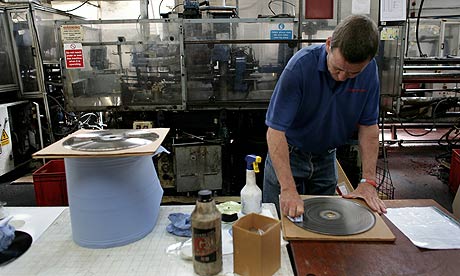
vinyl factory making vinyl records

One of the Vinyl Factory's staff cleaning the nickel stamper being it goes in the press -
it's a noisy job but the product is a thing of beauty. Photograph: Martin Godwin for the Guardian


Unwanted sounds

Another review of Garret Keizer's book The Unwanted Sound of Everything We Want: A Book About Noise published by Perseus, this tiome in the Guardian Review, by Steve Poole

The Unwanted Sound of Everything We Want: A Book About Noise, by Garret Keizer (Perseus, £16.99)
What is noise? In this thoughtfully soft-spoken and beautifully written polemic, Keizer considers noise as "unwanted sound" or "repulsive sound" or a "pollutant" or "sonic abuse": as he says, "The essential difference between music and noise is neither acoustic nor aesthetic but ethical." (Your favourite symphony might count as noise if your neighbour is blasting it out at 4am; while some people choose to incorporate the hum of machinery into sound art.) Keizer tells stories of noise disputes in cities; the harm done to birds, squirrels and whales by industrial noise; and, wryly, the surprising amount of noise it takes to make a book such as this one.

What, then, to do? Keizer would like planetary civilisation to become less noisy – which does not, he insists, mean less "festive" – for him, unamplified song and the sounds of non-motorised tools are rarely offensive. In the end, as Keizer shows, noise is basically about power: "A person who says 'My noise is my right' basically means 'Your ear is my hole'." To be read with Rage Against the Machine cranked up, but not too far, on headphones.


Tuesday, 22 June 2010

The voice of God?

Scientists are using data sonification to help find the higgs boson (the voice of god?). It's nice to see some high profile research at least considering an acoustic approach to fundamental problems of physics.

I've also included a link to LHCSound where the Sound Library where you can listen to the sounds and download mp3 files, numerical files and explanatory notes.

God particle signal is simulated as sound


Scientists have simulated the sounds set to be made by sub-atomic particles such as the Higgs boson when they are produced at the Large Hadron Collider.

Their aim is to develop a means for physicists at Cern to "listen to the data" and pick out the Higgs particle if and when they finally detect it.

Dr Lily Asquith modelled data from the giant Atlas experiment at the LHC.

She worked with sound engineers to convert data expected from collisions at the LHC into sounds.

"If the energy is close to you, you will hear a low pitch and if it's further away you hear a higher pitch," the particle physicist told BBC News.

"If it's lots of energy it will be louder and if it's just a bit of energy it will be quieter."

The £6bn LHC machine on the Swiss-French border is designed to shed light on fundamental questions in physics.

It is housed in a 27km-long circular tunnel, where thousands of magnets steer beams of proton particles around the vast "ring".

At allotted points around the tunnel, the beams cross paths, smashing together near four massive "experiments" that monitor these collisions for interesting events.

Scientists are hoping that new sub-atomic particles will emerge, revealing insights into the nature of the cosmos.

Atlas is one of the experiments at the LHC. An instrument inside Atlas called the calorimeter is used for measuring energy and is made up of seven concentric layers.

Each layer is represented by a note and their pitch is different depending on the amount of energy that is deposited in that layer.

The process of converting scientific data into sounds is called sonification.

Dr Asquith and her team have so far generated a number of simulations based on predictions of what might happen during collisions inside the LHC.

The team is only now feeding in real results from real experiments.

"When you are hearing what the sonifications do you really are hearing the data. It's true to the data, and it's telling you something about the data that you couldn't know in any other way," said Archer Endrich, a software engineer working on the project.

The aim is to give physicists at the LHC another way to analyse their data. The sonification team believes that ears are better suited than eyes to pick out the subtle changes that might indicate the detection of a new particle.

But Richard Dobson - a composer involved with the project - says he is struck at how musical the products of the collisions sound.

"We can hear clear structures in the sound, almost as if they had been composed. They seem to tell a little story all to themselves. They're so dynamic and shifting all the time, it does sound like a lot of the music that you hear in contemporary composition," he explained.

Although the project's aim is to provide particle physicists with a new analysis tool, Archer Endrich believes that it may also enable us to eavesdrop on the harmonious background sound of the Universe.

He said he hoped the particle collisions at Cern would "reveal something new and something important about the nature of the Universe".

And Mr Endrich says that those who have been involved in the project have felt something akin to a religious experience while listening to the sounds.

"You feel closer to the mystery of Nature which I think a lot of scientists do when they get deep into these matters," he said.

"Its so intriguing and there's so much mystery and so much to learn. The deeper you go, the more of a pattern you find and it's fascinating and it's uplifting."